5.12 稠密连接网络 (DenseNet)
ResNet 中的跨层连接设计引申出了数个后续工作。本节我们介绍其中的一个:稠密连接网络 (DenseNet) [1]。 它与 ResNet 的主要区别如图 5.10 所示。
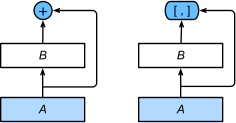
图 5.10 中将部分前后相邻的运算抽象为模块 和模块 。与 ResNet 的主要区别在于,DenseNet 里模块 的输出不是像 ResNet 那样和模块 的输出相加,而是在通道维上连结。这样模块 的输出可以直接传入模块 后面的层。在这个设计里,模块 直接跟模块 后面的所有层连接在了一起。这也是它被称为“稠密连接”的原因。
DenseNet 的主要构建模块是稠密块 (dense block) 和过渡层 (transition layer)。前者定义了输入和输出是如何连结的,后者则用来控制通道数,使之不过大。
5.12.1 稠密块
DenseNet 使用了 ResNet 改良版的“批量归一化、激活和卷积”结构,我们首先在 conv_block 函数里实现这个结构。
import time
import torch
from torch import nn, optim
import torch.nn.functional as F

import sys
sys.path.append("..")
import d2lzh_pytorch as d2l
device = torch.device('cuda' if torch.cuda.is_available() else 'cpu')

def conv_block(in_channels, out_channels):
    blk = nn.Sequential(nn.BatchNorm2d(in_channels),
                        nn.ReLU(),
                        nn.Conv2d(in_channels, out_channels, kernel_size=3, padding=1))
    return blk
稠密块由多个 conv_block 组成,每块使用相同的输出通道数。但在前向计算时,我们将每块的输入和输出在通道维上连结。
class DenseBlock(nn.Module):
    def __init__(self, num_convs, in_channels, out_channels):
        super(DenseBlock, self).__init__()
        net = []
        for i in range(num_convs):
            in_c = in_channels + i * out_channels
            net.append(conv_block(in_c, out_channels))
        self.net = nn.ModuleList(net)
        self.out_channels = in_channels + num_convs * out_channels # 计算输出通道数

    def forward(self, X):
        for blk in self.net:
            Y = blk(X)
            X = torch.cat((X, Y), dim=1)  # 在通道维上将输入和输出连结
        return X
在下面的例子中,我们定义一个有 2 个输出通道数为 10 的卷积块。使用通道数为 3 的输入时,我们会得到通道数为 的输出。卷积块的通道数控制了输出通道数相对于输入通道数的增长,因此也被称为增长率 (growth rate)。
blk = DenseBlock(2, 3, 10)
X = torch.rand(4, 3, 8, 8)
Y = blk(X)
Y.shape # torch.Size([4, 23, 8, 8])
5.12.2 过渡层
由于每个稠密块都会带来通道数的增加,使用过多则会带来过于复杂的模型。过渡层用来控制模型复杂度。它通过 卷积层来减小通道数,并使用步幅为 2 的平均池化层减半高和宽,从而进一步降低模型复杂度。
def transition_block(in_channels, out_channels):
    blk = nn.Sequential(
            nn.BatchNorm2d(in_channels),
            nn.ReLU(),
            nn.Conv2d(in_channels, out_channels, kernel_size=1),
            nn.AvgPool2d(kernel_size=2, stride=2))
    return blk
对上一个例子中稠密块的输出使用通道数为 10 的过渡层。此时输出的通道数减为 10,高和宽均减半。
blk = transition_block(23, 10)
blk(Y).shape # torch.Size([4, 10, 4, 4])
5.12.3 DenseNet 模型
我们来构造 DenseNet 模型。DenseNet 首先使用同 ResNet 一样的单卷积层和最大池化层。
net = nn.Sequential(
        nn.Conv2d(1, 64, kernel_size=7, stride=2, padding=3),
        nn.BatchNorm2d(64),
        nn.ReLU(),
        nn.MaxPool2d(kernel_size=3, stride=2, padding=1))
类似于 ResNet 接下来使用的 4 个残差块,DenseNet 使用的是 4 个稠密块。同 ResNet 一样,我们可以设置每个稠密块使用多少个卷积层。这里我们设成 4,从而与上一节的 ResNet-18 保持一致。稠密块里的卷积层通道数 (即增长率) 设为 32,所以每个稠密块将增加 128 个通道。
ResNet 里通过步幅为 2 的残差块在每个模块之间减小高和宽。这里我们则使用过渡层来减半高和宽,并减半通道数。
num_channels, growth_rate = 64, 32  # num_channels 为当前的通道数
num_convs_in_dense_blocks = [4, 4, 4, 4]

for i, num_convs in enumerate(num_convs_in_dense_blocks):
    DB = DenseBlock(num_convs, num_channels, growth_rate)
    net.add_module("DenseBlosk_%d" % i, DB)
    # 上一个稠密块的输出通道数
    num_channels = DB.out_channels
    # 在稠密块之间加入通道数减半的过渡层
    if i != len(num_convs_in_dense_blocks) - 1:
        net.add_module("transition_block_%d" % i, transition_block(num_channels, num_channels // 2))
        num_channels = num_channels // 2
同 ResNet 一样,最后接上全局池化层和全连接层来输出。
net.add_module("BN", nn.BatchNorm2d(num_channels))
net.add_module("relu", nn.ReLU())
net.add_module("global_avg_pool", d2l.GlobalAvgPool2d()) # GlobalAvgPool2d 的输出:(Batch, num_channels, 1, 1)
net.add_module("fc", nn.Sequential(d2l.FlattenLayer(), nn.Linear(num_channels, 10)))
我们尝试打印每个子模块的输出维度确保网络无误:
X = torch.rand((1, 1, 96, 96))
for name, layer in net.named_children():
    X = layer(X)
    print(name, ' output shape:\t', X.shape)
输出:
0  output shape:	 torch.Size([1, 64, 48, 48])
1  output shape:	 torch.Size([1, 64, 48, 48])
2  output shape:	 torch.Size([1, 64, 48, 48])
3  output shape:	 torch.Size([1, 64, 24, 24])
DenseBlosk_0  output shape:	 torch.Size([1, 192, 24, 24])
transition_block_0  output shape:	 torch.Size([1, 96, 12, 12])
DenseBlosk_1  output shape:	 torch.Size([1, 224, 12, 12])
transition_block_1  output shape:	 torch.Size([1, 112, 6, 6])
DenseBlosk_2  output shape:	 torch.Size([1, 240, 6, 6])
transition_block_2  output shape:	 torch.Size([1, 120, 3, 3])
DenseBlosk_3  output shape:	 torch.Size([1, 248, 3, 3])
BN  output shape:	 torch.Size([1, 248, 3, 3])
relu  output shape:	 torch.Size([1, 248, 3, 3])
global_avg_pool  output shape:	 torch.Size([1, 248, 1, 1])
fc  output shape:	 torch.Size([1, 10])
5.12.4 获取数据并训练模型
由于这里使用了比较深的网络,本节里我们将输入高和宽从 224 降到 96 来简化计算。
batch_size = 256
# 如出现“out of memory”的报错信息,可减小 batch_size 或 resize
train_iter, test_iter = d2l.load_data_fashion_mnist(batch_size, resize=96)

lr, num_epochs = 0.001, 5
optimizer = torch.optim.Adam(net.parameters(), lr=lr)
d2l.train_ch5(net, train_iter, test_iter, batch_size, optimizer, device, num_epochs)
输出:
training on  cuda
epoch 1, loss 0.0020, train acc 0.834, test acc 0.749, time 27.7 sec
epoch 2, loss 0.0011, train acc 0.900, test acc 0.824, time 25.5 sec
epoch 3, loss 0.0009, train acc 0.913, test acc 0.839, time 23.8 sec
epoch 4, loss 0.0008, train acc 0.921, test acc 0.889, time 24.9 sec
epoch 5, loss 0.0008, train acc 0.929, test acc 0.884, time 24.3 sec
小结
- 在跨层连接上,不同于 ResNet 中将输入与输出相加,DenseNet 在通道维上连结输入与输出。
- DenseNet 的主要构建模块是稠密块和过渡层。
参考文献
[1] Huang, G., Liu, Z., Weinberger, K. Q., & van der Maaten, L. (2017). Densely connected convolutional networks. In Proceedings of the IEEE conference on computer vision and pattern recognition (Vol. 1, No. 2).
注:除代码外本节与原书此节基本相同,原书传送门